Deep research, narrated.
Give Deep Research Audio a topic. It researches it like an analyst, checks the claims that matter, and hands back a narrated episode with every receipt attached.

An analyst’s week of reading, in one walk.
You hand it a subject and a few preferences. It does the work an analyst would do: maps the territory, gathers material, cross-checks the important claims against independent sources, plans a narrative, writes it, narrates it, and ships it as one shareable page.
Built for the way you actually want to take in hard topics: while walking, driving, or doing the dishes. Then the notes, the cheat sheet and the workbook bring it back for real study.
- Subject
- A sentence in your own words, with any sub-topics it must cover.
- Density
- Light and conversational, or packed with data.
- Length
- From a short briefing to a two-hour deep dive or a full course.
- Language
- Any language you name in the prompt.
Seven stages between your question and the first word you hear.
Research feeds the writing, the writing feeds the narration, and the source trail follows the whole way through. If the research cannot run, nothing is made. There is no quiet fallback to what a machine happens to remember.
Map the subject
Your prompt is laid out as a map of the people, places and ideas it touches, so nothing important is missed.
Go deep where it matters
It searches, reads full pages and pulls out the facts, the way an analyst works through a reading list.
Check the claims that carry weight
The claims an episode leans on are checked before a word is written.
Weigh the evidence
The best-supported facts lead. Weak ones are qualified or left out.
Plan the story
A research brief and a story plan come before the script, so the episode teaches rather than lists.
Write it and read it aloud
Long-form and sectioned, in the language you asked for, then narrated for listening rather than skimming, chapter by chapter.
Package and share
Audio, notes, cheat sheet and the source audit land together on one share page. No account, no app, no tracking.
Every episode keeps its receipts.
The facts that carry weight are checked, and each one gets a written verdict you can open and read.
- Confirmed
- Independent sources agree. Stated plainly.
- Partly confirmed
- Agreement with caveats, and the caveat is said.
- Not enough evidence
- The best figure is used, and flagged as limited.
- Contradicted
- Never stated as fact.
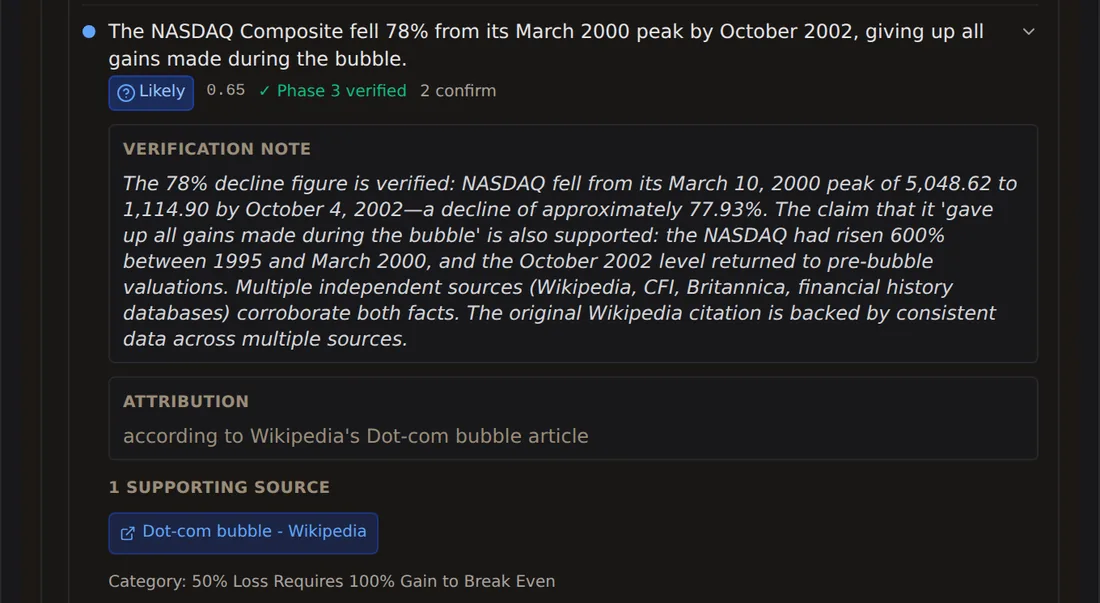
Nothing from thin air
Every episode is built from sources read during the research. Without sources, there is no episode.
Certainty you can hear
Strong claims are stated, weak ones are qualified, and disagreements between sources are shown, not hidden.
Open to inspection
Every share page lists its sources, graded for credibility, and the audit trail for each key fact. Listen, verify, then disagree.
One request. A complete kit, built on one body of evidence.
Notes, sheet, workbook and report are written from the same checked facts as the narration, so they never disagree with it.
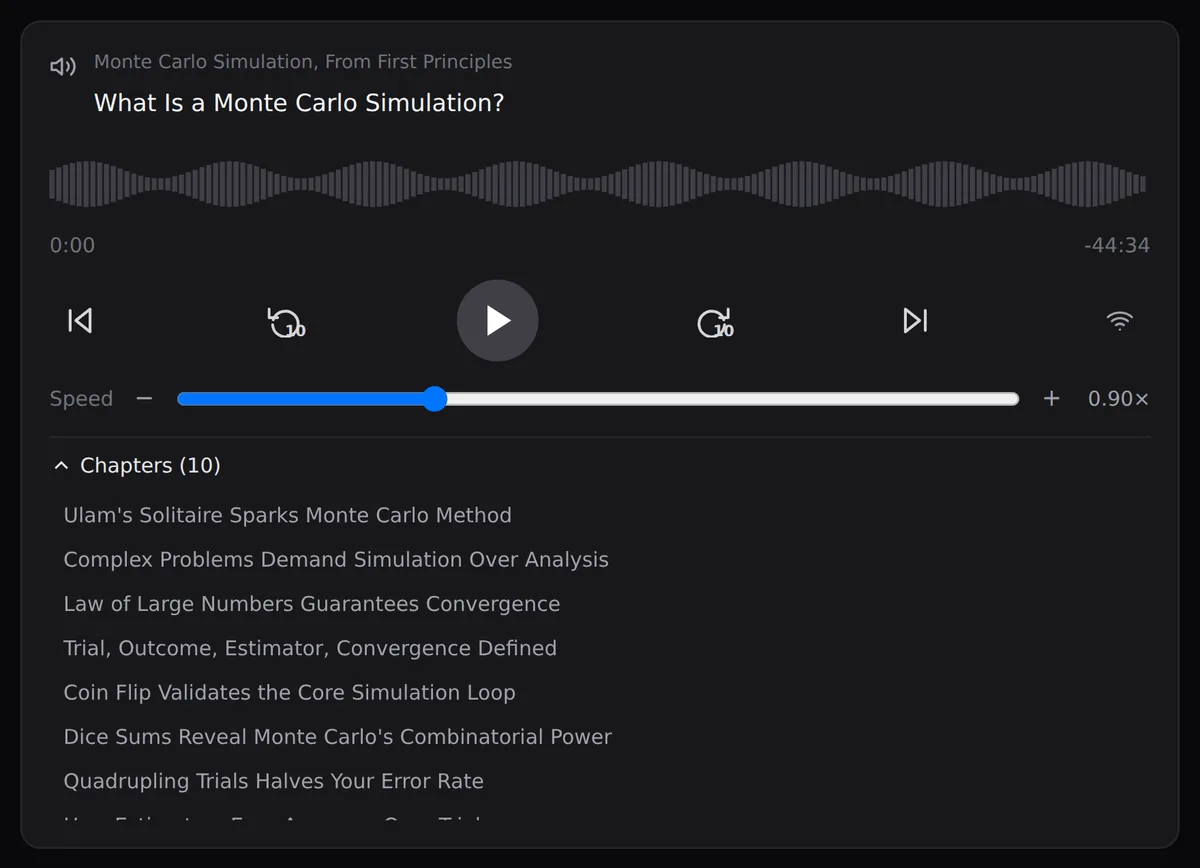
The narrated episode
Chapters that follow the sections, speed control, skips and offline listening. Courses show every module as it is made. This one is “What Is a Monte Carlo Simulation?”, 44 minutes in ten chapters.
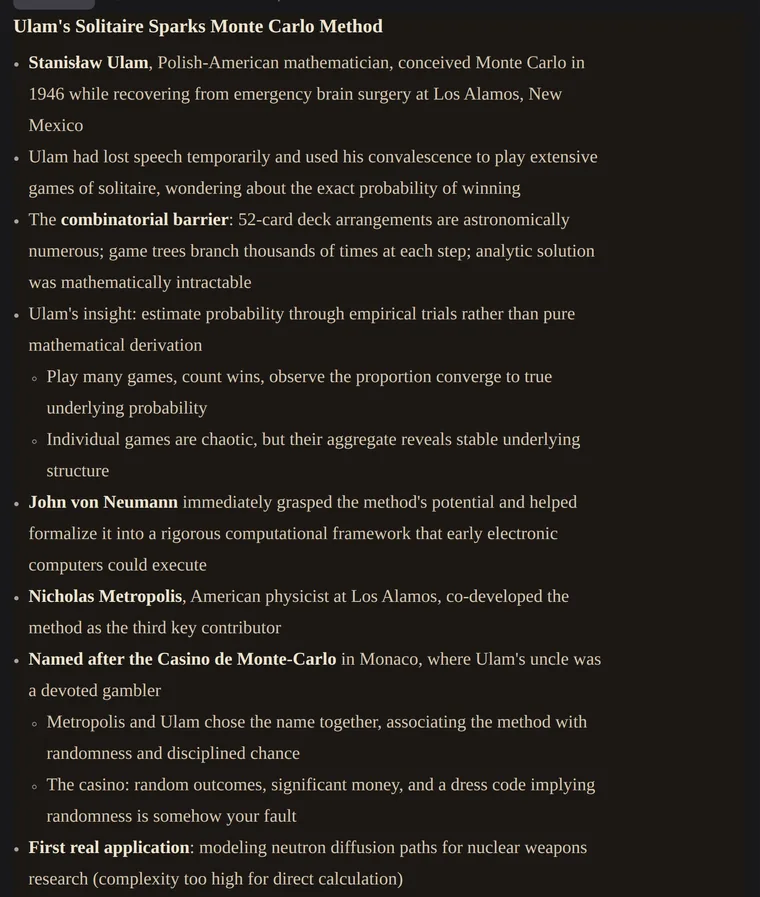
Study notes
Headings mirror the chapters. Names and key ideas stand out. Built for revision, not rereading.
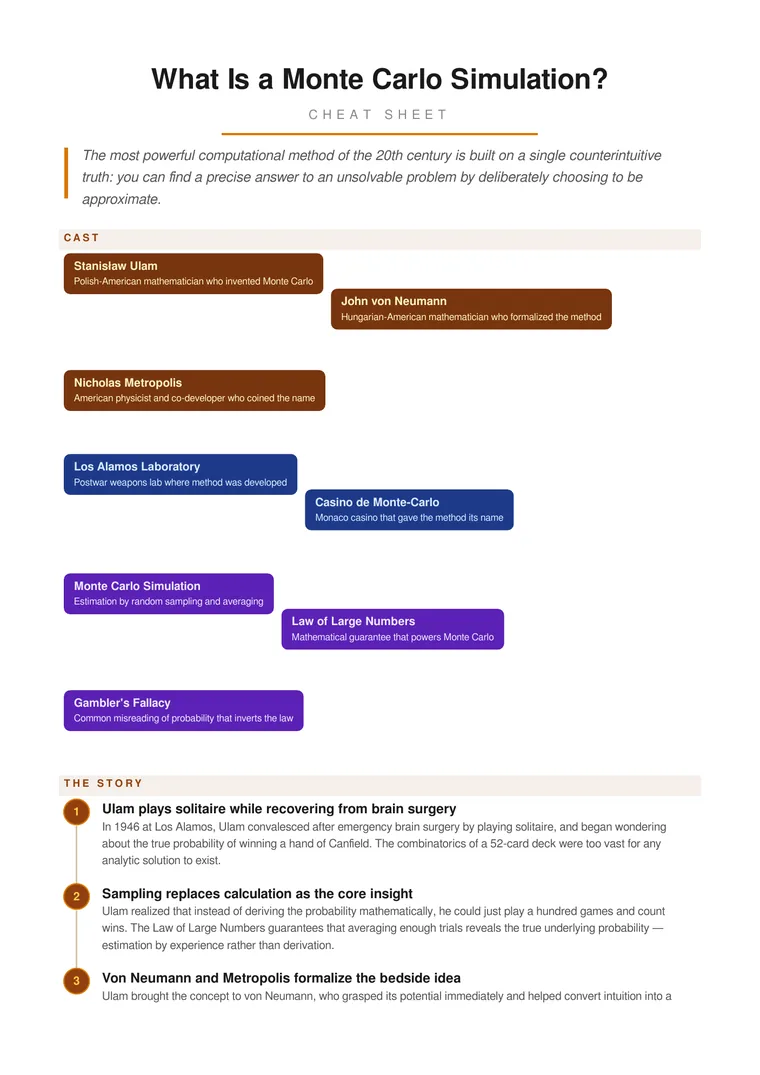
Cheat sheet
The whole episode on one printable page: the hook, the cast, the story, the connections and the numbers to remember.
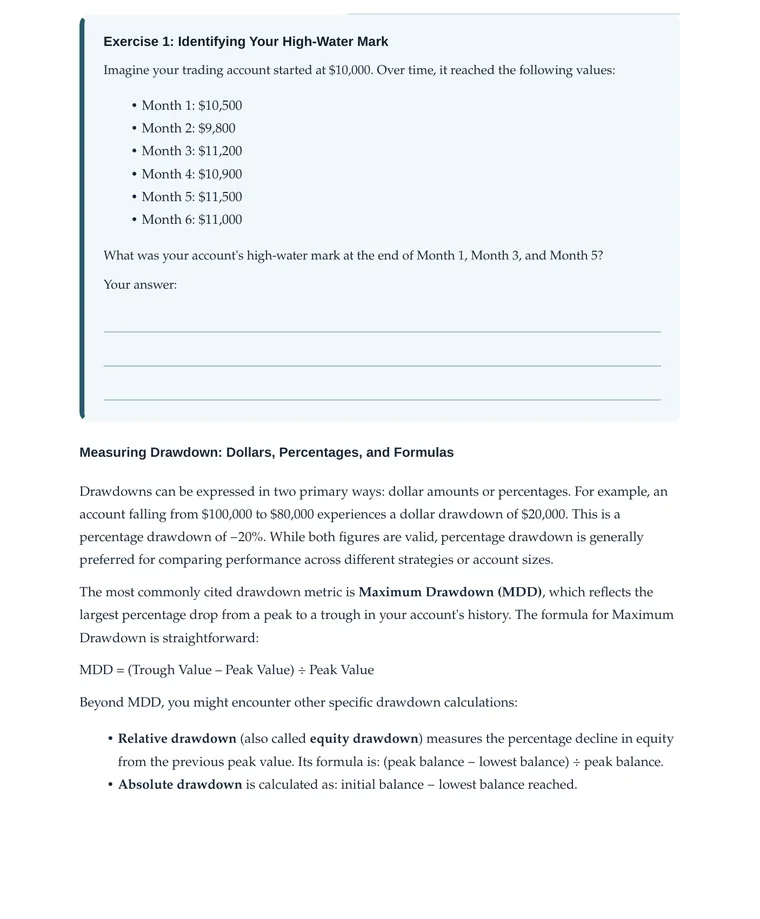
Workbook
Exercises with real figures, key-concept boxes, checklists and reflection prompts. Under the educast name or a partner’s own.
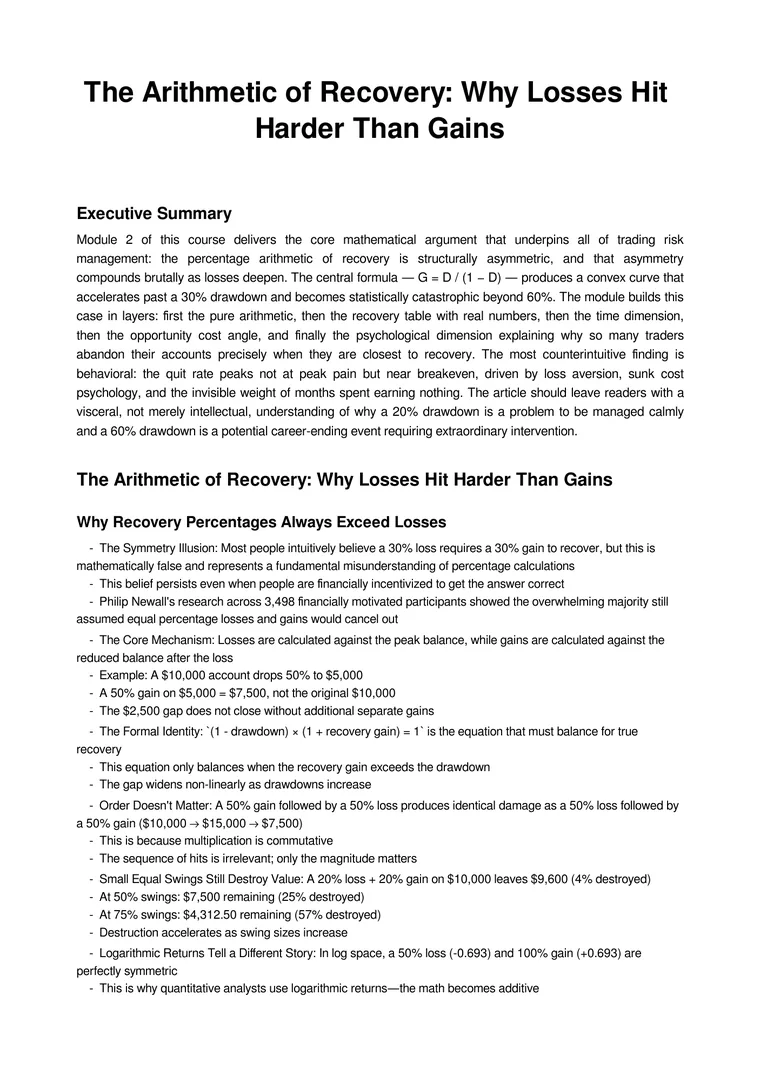
Research report
An executive summary, the key facts and the complete source list, ready to cite.
Reports export to PDF, Markdown, LaTeX and OpenDocument. Source lists export to RIS for Zotero and EndNote. Teachers can check an episode before they assign it, and students can follow the citations into the primary literature.
Listen for yourself.
Four real episodes, untouched, from courses already published on very different subjects. Each comes with the workbook or cheat sheet the system made from the same research.
-
The Reactivity Loop: What’s Really Happening in the Brain
Full module from “The Calm Walk Method” · Pup Class
-
The 5-to-1 Ratio That Predicts Stability
Excerpt from a 66-minute module of “Secrets of Lasting Love” · educast
-
The Inflection Point Around Thirty Percent
Excerpt from “The Arithmetic of Recovery”, free course “What Is Drawdown in Trading?” · IATACF
-
Multiple Testing and the False Discovery Problem
Excerpt from “Why Most AI Trading Claims Fail on Inspection”, free course “AI Trading: What Works and What Does Not” · IATACF
Already running on educast
- Pup ClassScience-backed dog training courses for owners.
- IATACFInstitute of Algorithmic Trading and Applied Computational Finance: courses and certificates.
- Pharma LecturesIn-company pharma courses for every role and every market.
- HEP MLMachine learning for high energy physics.
Any level, any language.
There is no grade-level switch. You set the audience in plain words and tune it with density and length. The same engine has made a friendly guide to teaching a dog to come back and a course on boosted decision trees built from physics preprints.
“for eighth graders”, “for first-year engineers”, “in Hungarian”, “auf Deutsch”
What people use it for
- Catching up on a complicated topic on a single walk instead of a week of reading.
- A personal explainer for a niche subject you actually care about.
- A book or a landmark paper, chapter by chapter, with where the field agrees and disagrees.
- Sharing your own research as a polished, listenable piece without running a podcast.
- The same episode in another language with one change to the prompt.
Every lesson, also as a hand-drawn film.
The same research and the same narration, animated scene by scene in a warm, hand-drawn style, with a recurring cast and your own palette. These three were finished end to end by the film maker. Press play.
Open for industry partners and collaborations.
If education, research-based consulting, onboarding or training matters to your organisation, educast can make it researched, narrated and checkable, under your name or ours. Tell us what you have in mind.
Education
Courses, modules and workbooks for schools, universities and academies, under your own name and in any language your learners speak.
Research-based consulting
A question your clients care about, researched and checked, delivered as an episode they can hear and a cited report they can verify.
HR onboarding and training
Onboarding tracks, policy refreshers and product knowledge that people actually finish, on a commute or between meetings.
Your own use
Associations, publishers, foundations and research groups that need hard material made clear without losing the evidence behind it.
Or write to our partnerships address. Every message is read and answered by the founder.
For universities and schools →About the creator
educast.cc is built by Ben Racz — founder and managing director of a scientific research company, head of its quantitative analysis practice, and Professor of the Practice at Carnegie Mellon University. Career split across two-plus decades of complex software work: distributed research infrastructure, quantitative trading strategy validation, execution and order-management systems, risk and monitoring, and information security — ISO 27001 and Sarbanes-Oxley implementation, PCI-DSS technical consulting and vulnerability testing, and published research in cyberwarfare. Contributor to Humanity’s Last Exam, published in Nature. Reach out, give feedback, or follow the work at benracz.com.